
The Weird
"No place worth knowing yields itself at sight, and those least inviting on first view may leave the most haunting pictures upon the walls of memory."

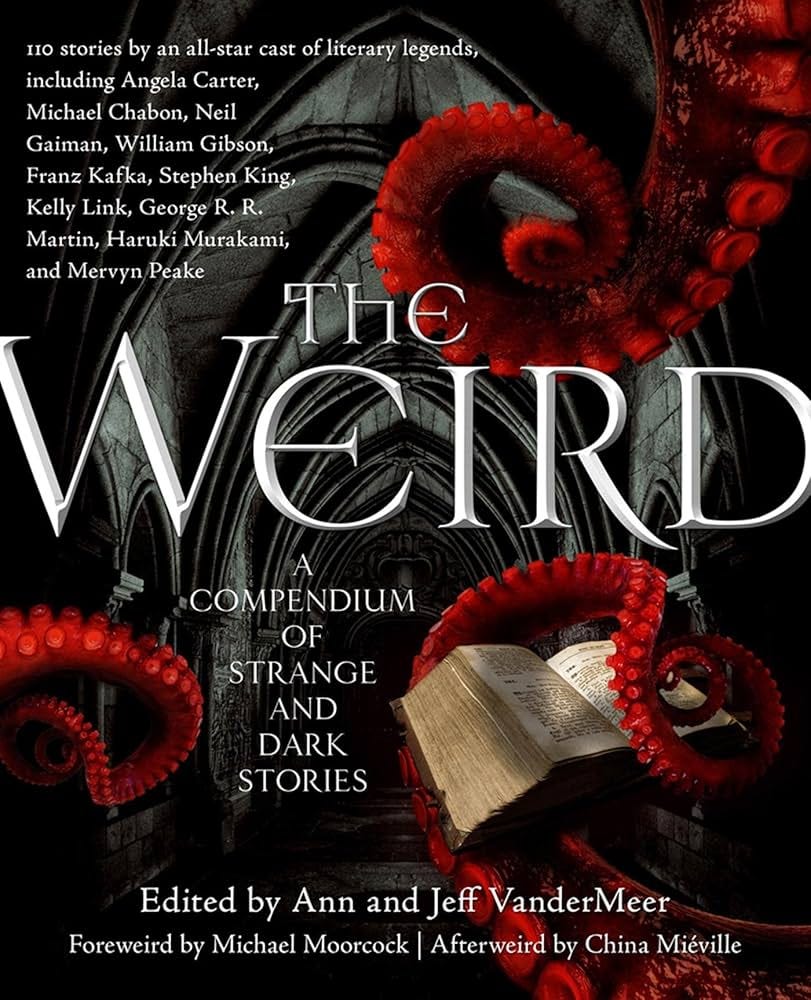
These are strange aeons. These texts dead and/or not, burrow, and we cannot predict everything they will infect or eat their path through. But certainly your brain, and they will eat the books you read from today on, too. That’s how the Weird recruits.
This is a worm farm. These stories are worms.China Miéville
Afterweird to The Weird
I didn’t grow up reading the stories of Algernon Blackwood or H.P. Lovecraft. I thought I was browsing. The genre had other plans.
What appealed to me, right away, was that the worlds these authors create are not obligated to make sense to the reader. Meaning leaks out of partial revelation, symbols that do not belong to any system we can recognize. Atmospheres that linger over rational explanations, like mist on a lake. It’s a staring into the abyss, which stares back. You look, and the looking continues without you.
Even literary fiction promises emotional clarity or moral insight. Weird fiction only promises contamination. You read and nothing resolves. You walk around with something skewed. Categories bend like spoons. Consensus softens. Weird fiction winks at that feeling.
It rejects the idea that rational systems are sufficient. The philosophical angle is easily recognizable. Kant’s thing-in-itself might be knowable, but the cost is lethal. The Cthulhu monster is the knowledge that humans are transcendentally locked into a narrow spectrum of existence and there are creatures of unintelligible being lurking in much more expansive bandwidths. Thomas Ligotti lifts his painted puppet cosmos from The Buddha’s Dhammapada, where extinction is the highest relief.
Schopenhauer’s Will shows itself most clearly in VanderMeer’s The Third Bear, where it erupts as a marauding creature rather than an inner drive. The villagers can do nothing. The Will walks on hind legs and tears through the village. It kills with absolute indifference. Heroes break. Representation collapses in its presence, and no metaphor survives it.
These authors are not writing from a philosophical framework, but from inside the wound it creates. Prizing mood over plot, ontology over psychology. Something unrecognizable exists, and yet it still warps the air.
I respect the authors who double down and accept the cost of this niche.
Simon Strantzas ends Beneath the Surface by detailing his writing process. Illness, cold walks, repeated rejections as proof that he is being haunted by a malevolent entity. He imagines sea monsters and hive minds burrowing into the unsuspecting. He becomes the haunting. The Weird writer does not record the breach. He offers himself to it.
Laird Barron is where cosmic horror learns the discipline of literary fiction. He creates mythos without frameworks, freestyle composing horror tales of masculinity, dread, and entropy. There is a vital energy that cracks through his short stories. Wild and unpredictable. His prose doesn’t flinch or comfort. When violence lands, it is as if the universe is speaking through the wound.
—Then he bites off my shooting hand. Christ on a pony, here’s a new dimension of pain. The universe flares white. A storm of dandelion seeds, a cyclone of fire. That’s the Coliseum on its feet, a full-blown orchestra, a cannon blast inside my skull.
Laird Barron
Bulldozer
He also lives in Alaska and has an eye patch. So he feels more like a Hideo Kojima character than a mortal.
The Weird suggests that the universe is indifferent, layered, maybe hostile to the seeker. But you don’t have to be so melodramatic about it. It just wants you to see what was always there, writhing in the bandwidth you couldn’t access. Now you see it. Now you can’t unsee it. The channel stays open.
Damn, I remember reading "It's a Good Life" as a part of some other anthology when I was a kid. It was overwhelming to conceive of that much power striking randomly with no way out. But in some fashion, all of us reside in Peaksville OH. The Universe / God / Reality / Life upholds our fragile little existences. There is so much we cannot control. Actually it pushes us to "release the tiller" (JMK) because perhaps we control nothing?
I love your review of interesting / relevant / insightful tomes. What's up for the next year? Any plans for original writing? Seems you'd be a natural given your breadth of scholarship and insight into the human condition.
That's a great anthology. The Vandermeers have wonderful taste and judgement.